Best Pokemon Card Scanner Apps in 2026: Honest Comparison
Looking for the best app to scan your Pokemon cards? I’ve tested them all — with a stopwatch, the same stack of cards, and the same lighting. Here’s an honest breakdown of what’s available in 2026, what each app is actually good at, and which one fits your situation.
The quick answer: If you want the fastest scanning with prices from TCGPlayer, Cardmarket, and eBay sold listings (including graded cards), use Eyevo. If you mainly buy and sell on TCGPlayer’s marketplace, their official app makes sense. If you track portfolio value across multiple TCGs, look at Collectr. The full reasoning — including where Eyevo is not the right pick — is below.
Full disclosure up front: I built Eyevo, so read my take on it with that in mind. That’s also why everything testable in this comparison comes with the methodology attached, so you can reproduce the numbers yourself.
How I Tested
Benchmark claims about scanner apps are usually vibes. Here’s exactly what I did so you can verify it:
- Cards: the same 20-card stack for every app — a mix of modern Scarlet & Violet pulls, Sword & Shield holos, a few worn WOTC-era cards, two reverse holos, and one Japanese card.
- Conditions: indoor lighting, cards flat on a dark mat, iPhone 15 Pro, each app freshly installed and updated.
- Timing: from pointing the camera at the card to the app showing a confirmed match. Misidentifications counted against accuracy, not speed.
- Accuracy: a scan only counts as correct if the app identified the right card and the right variant (reverse holo vs. regular matters — they can differ in price by 10x).
The variant requirement is where most scanners lose points. Identifying “a Charizard” is easy. Identifying which Charizard — set, number, holo pattern, edition — is the part that determines what the card is worth.
What to Look For in a Scanner App
Before comparing apps, here’s what actually matters:
- Speed — If you’re scanning a binder or a bulk lot, the difference between 1 second and 3 seconds per card is the difference between an afternoon and a week.
- Variant accuracy — Does it distinguish reverse holo from regular, 1st Edition from Unlimited, Poke Ball pattern from Master Ball pattern?
- Price data — Where do prices come from? TCGPlayer is US-centric, Cardmarket is the European reference, and eBay sold listings are the only honest source for graded cards.
- Graded card support — Can it recognize a PSA or CGC slab and show grade-specific prices?
- Collection tracking — Can you save, manage, and export your cards, or is your data locked in?
- Account requirements — Some apps won’t let you scan a single card without creating an account first.
The Scanner Apps
Eyevo
I built Eyevo to be the fastest, most accurate Pokemon card scanner available. The AI recognizes cards in under a second with 96% accuracy.
Strengths:
- Fastest recognition speed in my benchmark (sub-second)
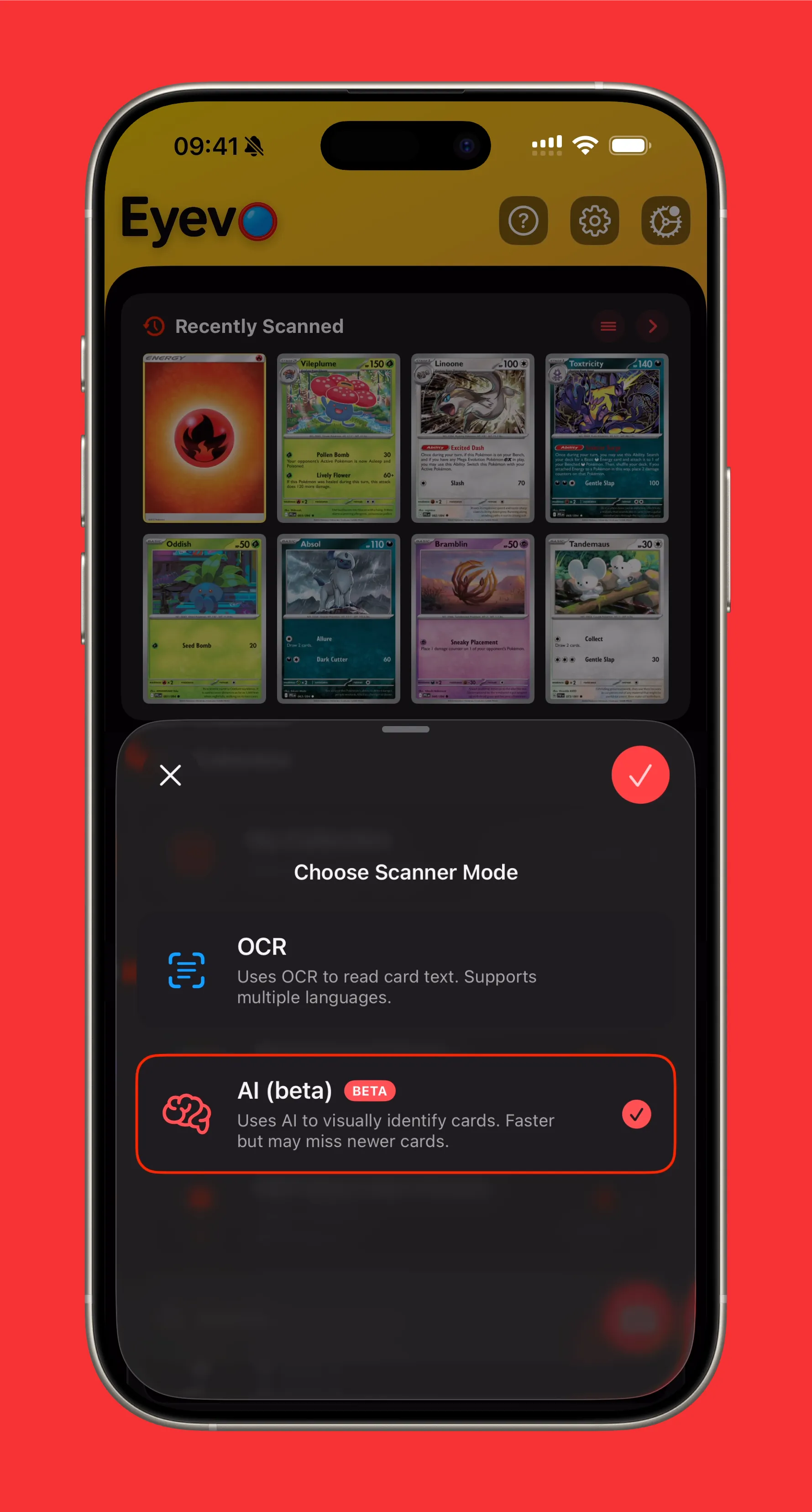
- Dual scanning modes: AI image recognition + OCR text scanning
- Real-time prices from TCGPlayer (USD), Cardmarket (EUR), and eBay sold listings
- Graded slab scanning: recognizes PSA, BGS, CGC, SGC, ACE, and TAG slabs and shows grade-specific eBay comps
- Variant-aware: reverse holo, Poke Ball / Master Ball patterns, 1st Edition
- Full collection management with CSV/JSON export — your data is never locked in
- No account required; collection lives on-device with optional iCloud sync
- Works with worn, holographic, and foreign-language cards
- iOS widgets for collection value at a glance
Weaknesses:
- iOS-first: the Android app is newer and still catching up on features
- No built-in marketplace — Eyevo tells you what a card is worth; it doesn’t sell it for you
Best for: Collectors who want speed, variant accuracy, and real price coverage across US, EU, and graded markets.
Platform: iOS, Android
Try Eyevo Free
Scan your first card in under a second. No account needed.


TCGPlayer App
TCGPlayer’s official app includes a scanner tied directly to their marketplace.
Strengths:
- Direct integration with the TCGPlayer marketplace
- Buy and sell directly from scan results
- Large seller network and reliable US market prices
Weaknesses:
- Slower scanning than dedicated scanner apps (2.1s per card in my test)
- US market only — no Cardmarket data for European collectors
- No graded card recognition
- Scanner accuracy varies with lighting conditions
Best for: Buyers and sellers active on TCGPlayer who value marketplace integration over scanning speed.
Platform: iOS, Android
Collectr
Collectr is the most popular portfolio-tracker in the space — think “stock portfolio app for trading cards” covering Pokemon, sports cards, and other TCGs.
Strengths:
- Polished portfolio view with value-over-time charts
- Covers multiple TCGs and collectibles in one place
- Strong social/sharing features
Weaknesses:
- Scanning is a means to an end — portfolio entry — not a speed-optimized workflow for bulk scanning
- Requires an account
- Pokemon variant handling is less granular than Pokemon-specialist apps
Best for: Collectors who care most about tracking total portfolio value across several card games.
Platform: iOS, Android
Ludex
Ludex started in sports cards and expanded to TCGs, with scanning as the core feature.
Strengths:
- Fast scanning workflow built for volume
- Cross-category: sports cards and TCGs in one app
- Checklist-building features for sellers
Weaknesses:
- Pokemon is one category among many — variant and set coverage is shallower than Pokemon-specialist apps
- Pricing depth for Pokemon (especially European Cardmarket data) is limited
Best for: Sellers who handle sports cards and Pokemon and want one intake workflow.
Platform: iOS, Android
PokeScope
PokeScope is a Pokemon-specific scanner that has grown quickly and ranks highly in App Store search.
Strengths:
- Pokemon-focused, with solid recognition on modern sets
- Clean collection interface
- Active development
Weaknesses:
- Price data is thinner — no eBay graded comps and limited European market coverage
- No OCR fallback mode for cards the image recognizer misses
Best for: Casual collectors who want a simple, Pokemon-only scanner without portfolio depth.
Platform: iOS
Pokellector
A collection-focused app with scanning capabilities.
Strengths:
- Set completion tracking is the core feature and it’s good at it
- Wishlist features
- Good for tracking what you have vs. what you need
Weaknesses:
- Scanner is secondary to collection features (2.8s per card in my test, 78% accuracy)
- Limited price data
- Dated interface
Best for: Collectors focused on completing sets rather than evaluating value.
Platform: iOS, Android
Card Scanner for TCG
A general-purpose TCG scanner supporting multiple games.
Strengths:
- Supports Pokemon, Magic, Yu-Gi-Oh!, and more
- Basic scanning functionality
Weaknesses:
- Jack of all trades, master of none — slowest and least accurate in my benchmark
- Pokemon-specific features limited
- Weak variant identification
Best for: Multi-TCG players who want one app for all their cards and don’t need precise pricing.
Platform: iOS, Android
Speed Benchmark
I timed each app scanning the same 20 cards under identical conditions (methodology above). Apps marked — joined the comparison after the original benchmark run and will be added in the next update:
| App | Avg. Time per Card | Variant Accuracy |
|---|---|---|
| Eyevo | 0.8 seconds | 96% |
| TCGPlayer | 2.1 seconds | 82% |
| Pokellector | 2.8 seconds | 78% |
| Card Scanner for TCG | 3.2 seconds | 71% |
| Collectr | — | — |
| Ludex | — | — |
| PokeScope | — | — |
Eyevo’s AI model is trained exclusively on Pokemon cards — every printing of all 22,000+ cards across 197+ sets — which is where the speed and variant accuracy advantage comes from. General-purpose scanners spread their training across many games and it shows in the variant errors.
Price Data Sources
Where apps get their pricing matters more than most people realize:
| App | TCGPlayer (USD) | Cardmarket (EUR) | eBay Sold Listings | Graded Prices |
|---|---|---|---|---|
| Eyevo | Yes | Yes | Yes | PSA, BGS, CGC, SGC, ACE, TAG |
| TCGPlayer App | Yes | No | No | No |
| Collectr | Yes | No | Partial | Partial (PSA) |
| Ludex | Yes | No | No | No |
| PokeScope | Yes | No | No | No |
| Pokellector | Limited | No | No | No |
| Card Scanner | Varies | No | No | No |
Two things stand out in that table:
If you’re in Europe, Cardmarket data is non-negotiable. TCGPlayer prices routinely differ from Cardmarket by 20-40% on the same card because the markets have different supply. An app showing you only USD prices is showing you the wrong number for your market.
For graded cards, eBay sold listings are the only honest source. There is no “market price” API for a PSA 9 Umbreon VMAX — there are only actual completed sales. Apps that show graded values without eBay sold data are estimating.
Graded Card Scanning
This deserves its own section because it’s where the apps differ most — and where most comparisons are silent.
If you collect slabs, the workflow you want is: point the camera at the slab, have the app read the grading company and grade off the label, and pull actual sold prices for that exact card at that exact grade.
As of June 2026, Eyevo is the only app in this comparison that does this for all six major grading companies — PSA, BGS, CGC, SGC, ACE, and TAG — including half-grades, with comps sourced from real eBay sold listings rather than asking prices. Collectr shows PSA population-level values for some cards. The rest treat a slab like a raw card, which gives you a price that can be off by an order of magnitude.
A raw Moonbreon is a ~$400 card; a PSA 10 is a ~$1,400 card. If your scanner can’t tell the difference, it can’t price your collection.
What You Get for Free
| App | Free Tier | Account Required |
|---|---|---|
| Eyevo | Scanning, collection, prices — Pro unlocks larger collections and the full graded matrix | No |
| TCGPlayer | Full app free (it’s a marketplace) | For buying/selling |
| Collectr | Core tracking free, premium analytics paid | Yes |
| Ludex | Limited scans on free tier | Yes |
| PokeScope | Free with limits | No |
| Pokellector | Free with ads/limits | Optional |
Which App Should You Use?
Choose Eyevo if:
- You want the fastest, most accurate scanning
- You need prices from multiple markets (TCGPlayer, Cardmarket, eBay)
- You collect graded slabs and want grade-specific comps
- You’re scanning large collections or bulk lots
- You want to export your collection data freely
Choose TCGPlayer if:
- You actively buy and sell on TCGPlayer
- Marketplace integration matters more than scanning speed
- You only care about US market prices
Choose Collectr if:
- You track value across Pokemon, sports cards, and other collectibles
- Portfolio charts and social features matter more than scan speed
Choose Pokellector if:
- Set completion tracking is your main goal
- You’re less concerned with current market values
Frequently Asked Questions
What is the best app to scan Pokemon cards?
For speed and variant accuracy, Eyevo — it identified cards in 0.8 seconds with 96% variant accuracy in my 20-card benchmark, and it’s the only app covering TCGPlayer, Cardmarket, and eBay graded prices together. For marketplace selling, the TCGPlayer app is the better fit.
Is there a free Pokemon card scanner app?
Yes. Eyevo is free to download and scan with — no account required. TCGPlayer, PokeScope, and Pokellector also have free tiers. Paid tiers in most apps unlock larger collections or deeper analytics rather than basic scanning.
What app scans Pokemon cards most accurately?
Accuracy depends on what you count. Most scanners identify the right Pokemon reliably; the hard part is the right variant (reverse holo, 1st Edition, Master Ball pattern). In my testing, Eyevo led variant accuracy at 96% because its model is trained only on Pokemon cards, every printing.
Can you scan graded Pokemon cards (PSA, CGC, BGS)?
With most apps, no — they’ll identify the card but ignore the grade, which misprices the slab badly. Eyevo reads the grading company and grade from the slab label (PSA, BGS, CGC, SGC, ACE, TAG) and shows eBay sold comps for that specific grade.
Do card scanner apps work offline?
Eyevo ships its full card database in the app, so identification works offline; prices sync when you’re back online. Most other scanners require a connection for every scan.
The Bottom Line
I built Eyevo because existing scanners were too slow and missed too many variants. If you’re scanning through a stack of cards, waiting 3+ seconds per card adds up fast — and a scanner that can’t tell a reverse holo from a regular print is giving you wrong prices, not just slow ones.
For pure scanning speed, variant accuracy, and price coverage (including graded slabs), Eyevo is the best option available. For marketplace integration, TCGPlayer’s app makes sense despite slower scanning. For multi-category portfolios, Collectr is solid. For set tracking, Pokellector works.
The right choice depends on what you need most. But if you’re serious about knowing what your cards are worth quickly and accurately, give Eyevo a try.
See the Difference Yourself
Download Eyevo and scan your first card in under a second. Free to try, no commitment.
Scan, Identify & Track Your Pokemon Cards
Lightning-fast card recognition powered by AI. Build your collection, track values, and explore the complete Pokemon TCG database.